
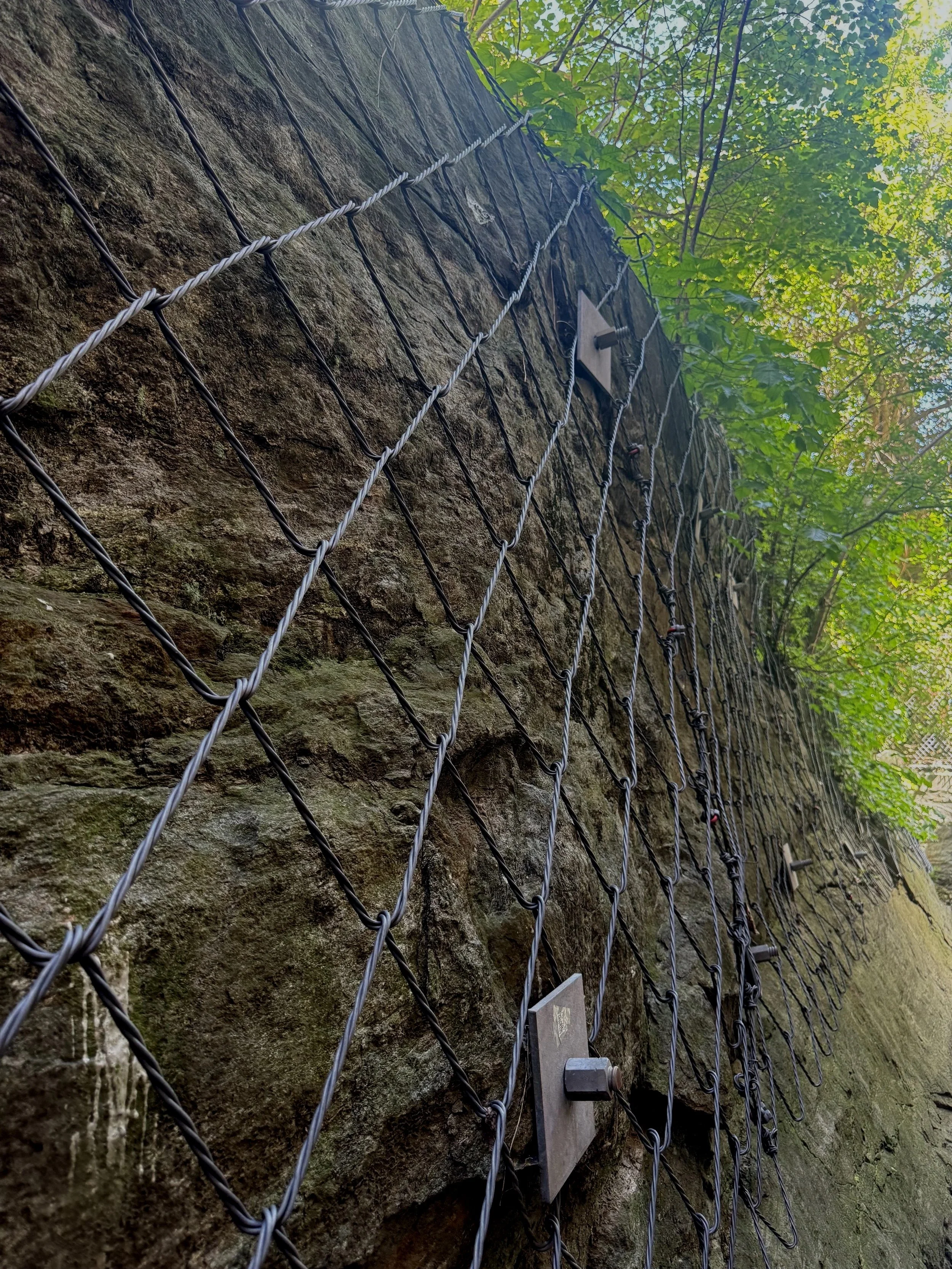
Retaining Wall Inspections
Retaining Wall Inspections
Periodic critical examination and condition reporting for New York City retaining walls under 1 RCNY §103-09. Post & Lintel supports property owners through QRWI coordination, structural assessment, TR16 filing, and repair management across all five boroughs.
Retaining walls are among the least visible — and most overlooked — structural elements subject to mandatory NYC DOB inspection requirements.
Under Article 305 of Title 28 of the NYC Administrative Code and DOB Rule 1 RCNY §103-09, owners of retaining walls that are ten feet or more in height and front a public right-of-way are required to have those walls critically examined by a Qualified Retaining Wall Inspector (QRWI) once every five years, with results filed with the Department of Buildings. The current cycle — Cycle 3 — runs from January 1, 2024 through December 31, 2028.
Unlike façade inspections, retaining wall filings follow a borough-by-borough staggered schedule rather than a block-number system. Each borough has a one-year filing window within the five-year cycle. Citywide, approximately 2,423 properties are subject to the retaining wall inspection program — a relatively small universe compared to FISP, but one where penalties for non-compliance are substantial and enforcement has been strengthened beginning with Cycle 3.
What Triggers the Requirement
The inspection requirement applies when two conditions are both met: the retaining wall is ten feet or more in height at any point along its length, and the wall fronts on a public right-of-way — meaning it abuts a public street, sidewalk, alley, or other public space that the public can freely approach. Height is measured as the vertical distance from the ground surface above the toe of the wall to the top of the wall, stem, or step for tiered walls, including any parapets or fencing intended for retaining material.
Walls that are shared between neighboring properties may be inspected by a single QRWI retained jointly by the owners, but each property owner must still pay their applicable filing fees and a separate acceptable report must be filed for each property.
Filing Windows by Borough
Cycle 3 runs from January 1, 2024 through December 31, 2028. Unlike FISP, which staggers deadlines by block number, retaining wall inspections are staggered by borough — each borough has a one-year window within the five-year cycle. The report must be filed with the DOB within 60 days of completing the inspection, and no later than the end of the applicable borough's filing window.
| Borough | Cycle 3 Filing Window | Status |
|---|---|---|
| Bronx | Jan 1, 2024 – Dec 31, 2024 | Filing window closed — late filings subject to penalties |
| Manhattan | Jan 1, 2025 – Dec 31, 2025 | Filing window closed — late filings subject to penalties |
| Staten Island | Jan 1, 2026 – Dec 31, 2026 | Filing window open |
| Queens | Jan 1, 2027 – Dec 31, 2027 | Upcoming — engage QRWI early |
| Brooklyn | Jan 1, 2028 – Dec 31, 2028 | Upcoming |
Penalties Now Apply Beginning with Cycle 3
A significant change took effect with Cycle 3: beginning with this cycle, owners who fail to file an acceptable retaining wall compliance report by the due date are subject to the civil penalties listed in 1 RCNY §103-09. In prior cycles, the penalty framework was not enforced in the same way. Property owners who missed the Bronx or Manhattan windows without filing should consult directly with the DOB or a licensed professional regarding their options.
2025 Rule Amendments
Effective March 23, 2025, the DOB implemented amendments to 1 RCNY §103-09. Among the notable changes: QRWIs no longer need prior DOB approval before commencing inspections — they must instead follow accepted standards of care and design an inspection program that allows for a complete review of the wall. Updated documentation standards now require that unsafe or repair-required conditions be supported by photographs and a mapped layout. Report labeling and follow-up filing requirements were also clarified.
Qualified Retaining Wall Inspectors (QRWIs)
Retaining wall inspections under 1 RCNY §103-09 may only be performed by a Qualified Retaining Wall Inspector — a New York State licensed Professional Engineer designated by the NYC DOB as a QRWI. Only a QRWI can file the TR16 report with the Department.
QRWI Qualifications
QRWIs must be New York State licensed Professional Engineers in good standing with both the New York State Education Department and the NYC Department of Buildings. They must maintain the insurance coverage required under 1 RCNY §101-07, copies of which must be made available to the DOB upon request. Professional Engineers, individuals with a bachelor's degree in engineering and three years of relevant experience, or individuals with five years of relevant experience may be delegated to perform selected inspection tasks under a QRWI's direct supervision — but the QRWI must personally perform the final inspection and sign the report.
What the Critical Examination Involves
Before performing the critical examination, the QRWI must review the most recent prior report, any available previous reports, structural design or repair drawings, and any open violations. A drive-by inspection is not acceptable — the QRWI must examine the full length of the wall from both sides. The inspection program must account for retaining wall type, cross-sections, architectural finishes, drainage conditions, selective probes, wall dimensions, and all surrounding elements that affect the wall's stability.
What the Retaining Wall Assessment Covers
The critical examination must permit a complete review of the wall's structural condition and all elements that affect its performance and stability. The following areas are assessed as part of the QRWI's inspection program.
- Overall wall stability and alignment
- Structural cracking — horizontal, diagonal, and through-wall
- Tilting, leaning, and displacement
- Bulging and outward movement
- Masonry condition — stonework, brick, concrete block
- Concrete spalling and surface deterioration
- Mortar joint condition and repointing needs
- Wire basket and gabion integrity
- Drainage system condition and function
- Water infiltration and saturation signs
- Vegetation growth and root intrusion
- Soil erosion above and below the wall
- Adjacent slope and embankment conditions
- Footing and toe condition (where accessible)
- Parapets and fencing attached to the wall
- Wall dimensions and cross-section measurements
TR16 Report Requirements
The QRWI must file a written Report of Critical Examination — designated TR16 — with the DOB within 60 days of completing the inspection. Reports are submitted as PDF files via email to LL37RetainingWalls@buildings.nyc.gov along with a Retaining Wall Inspection Report Program Intake Form (RWIP6) listing each wall submitted. DVD, CD, flash drive, and paper reports are not accepted.
The TR16 report must include: the property address and Block and Lot number; a description of the wall's construction type, materials, height, and dimensions; a cross-section drawing of the retaining wall; detailed structural engineering calculations; documented conditions with photographs and mapped layout (required as of the March 2025 amendments for walls rated SREM or Unsafe); the final wall rating; and a copy submitted to the building owner. A separate acceptable report must be prepared and filed for each property with a qualifying retaining wall.
Wall Ratings Under 1 RCNY §103-09
Following the critical examination, the QRWI assigns one of four condition ratings to the retaining wall. Each rating carries distinct compliance obligations for the property owner.
Safe
The wall is stable and in good condition with no defects or risks to public safety identified. No immediate maintenance or repairs are required. The TR16 report is filed and the property remains in compliance until the next inspection cycle.
Safe with Minor Repairs (SMR)
Minor defects are present — such as small surface cracks, vegetation growth, or weathering — that do not affect structural integrity but should be addressed to prevent further deterioration. Routine maintenance or minor repairs are documented in the report with a recommended timeline.
Safe with Repairs & Engineering Monitoring (SREM)
The wall is currently safe but has conditions — such as noticeable cracking, slight tilting, or drainage deficiencies — that require repair within the five-year period (no sooner than one year after filing) to prevent deterioration into an Unsafe condition. In addition to repair, the QRWI deems ongoing engineering monitoring necessary to assess the wall's stability and determine what further action may be required.
Unsafe
The wall has conditions posing an immediate hazard to persons or property — including significant cracking, severe tilting, bulging, or partial collapse. The owner must immediately take measures to secure public safety and complete all repairs within 365 days of filing. Within two weeks of completing repairs, the QRWI must re-inspect the wall, obtain any required permit sign-offs, and submit an amended TR16 report.
Steps for Retaining Wall Compliance
The following outlines the standard path for meeting the DOB's retaining wall inspection requirement within the applicable borough's Cycle 3 filing window.
Common Retaining Wall Conditions in NYC
Retaining walls in New York City's built environment face unique stresses — saturated soil, freeze-thaw cycling, hydrostatic pressure, root intrusion from adjacent urban plantings, and vibration from nearby transit infrastructure. Many of the city's retaining walls were constructed decades ago with materials and drainage details that require ongoing attention.
Drainage Failure
Inadequate or blocked drainage is the leading contributor to retaining wall deterioration in urban environments. When water cannot drain freely from the soil behind the wall, hydrostatic pressure builds against the wall face — increasing lateral load beyond the wall's design capacity and accelerating cracking, leaning, and eventual failure. Drainage inspections, outlet cleaning, and repair or replacement of drainage systems are among the most common interventions following retaining wall assessments.
Masonry Cracking and Displacement
Horizontal cracks near the base of a masonry retaining wall, diagonal cracks from corners, or cracks with displacement — where one side of the crack has shifted relative to the other — are structural red flags requiring engineering evaluation. Vertical cracking in concrete walls and spalling of the concrete face are common in older walls and may indicate rebar corrosion or freeze-thaw damage within the wall section.
Tilting and Leaning
Walls that have rotated or displaced outward from their original position are exhibiting movement that indicates the forces being retained exceed the wall's passive resistance. Even small amounts of measurable lean — particularly when progressive — warrant engineering monitoring and may require structural intervention, anchoring, or buttressing to stabilize.
Vegetation and Root Intrusion
Trees and substantial shrubs growing adjacent to or from within retaining wall joints introduce root pressure that can dislodge masonry, crack concrete, and undermine mortar joints over time. Vegetation management is often a recommended maintenance measure following inspection, and repointing or masonry repair may be required in affected areas.
Penalties for Non-Compliance
Beginning with Cycle 3, the DOB now actively enforces civil penalties for failure to file an acceptable retaining wall compliance report by the applicable borough deadline. Penalty amounts are set under 1 RCNY §103-09 and are assessed for each reporting period in which a required report is not filed.
The original site penalty structure specified in 1 RCNY §103-09 includes an initial fine of $1,000 for failure to file, with an additional $250 per month the report remains unfiled. Additional fines may be imposed for failure to complete required repairs within the timeframes specified in a filed report. For Unsafe conditions, failure to install required public protection or complete repairs within the 365-day window may result in further enforcement action.
Late Filing After the Borough Window Closes
Property owners whose borough filing window has already closed — Bronx (2024) and Manhattan (2025) — without a filed report should not delay further. Penalties accrue from the deadline date and the DOB has posted detailed penalty payment and waiver request instructions. Questions regarding specific property status and penalty exposure can be directed to LretainingWalls@buildings.nyc.gov.
Post & Lintel Retaining Wall Services
Post & Lintel supports property owners through every phase of the retaining wall inspection and compliance process. Field observations and documentation may be performed by trained personnel; all regulated evaluations, wall ratings, and DOB filings are handled by appropriately licensed professionals.
- Applicability and height verification
- Borough sub-cycle and deadline confirmation
- Prior report and violation record review
- QRWI engagement and coordination
- Critical examination coordination
- Visual and structural condition documentation
- Cracking and displacement observation
- Drainage condition assessment support
- Photographic and mapped documentation
- TR16 report preparation and DOB filing
- RWIP6 intake form submission
- SMR repair scope and scheduling
- SREM engineering monitoring coordination
- Unsafe condition response support
- Repair permit coordination
- Masonry and drainage repair coordination
- Amended TR16 filing upon repair completion
- Shared-wall multi-owner coordination
Who We Work With
Retaining walls subject to inspection requirements are found across a wide range of property types in New York City — particularly in areas with significant grade changes, transportation infrastructure, and older urban development patterns.
Frequently Asked Questions
How do I know if my wall is subject to inspection?
Two conditions must both be met: the wall is ten feet or more in height at any point along its length, and it fronts a public right-of-way. The DOB maintains a retaining wall universe map that lists known subject properties, but it is ultimately the owner's responsibility to determine applicability regardless of whether the property appears on the city's list.
Can a licensed architect perform the inspection?
No. Unlike FISP, which accepts both licensed architects and engineers as QEWIs, retaining wall inspections under 1 RCNY §103-09 must be performed by a licensed Professional Engineer designated by the DOB as a QRWI. Registered Architects are not eligible to perform or file retaining wall inspections.
My wall is shared with a neighbor — who files the report?
Neighboring property owners may jointly retain a single QRWI to inspect a shared wall. However, a separate acceptable TR16 report must be filed for each property, and each owner is responsible for their applicable filing fees. Coordinating early with adjacent owners typically reduces cost and scheduling complexity.
What if my wall is less than ten feet tall?
Walls under ten feet are not subject to the periodic inspection requirement under 1 RCNY §103-09. However, all property owners remain responsible under the NYC Administrative Code for maintaining all structures on their property — including retaining walls of any height — in a safe condition at all times. DOB can issue violations for any retaining wall found to present a safety hazard, regardless of height.
How long does the owner have to repair an Unsafe wall?
All repairs to correct an Unsafe condition must be completed within 365 days of filing the Unsafe TR16 report with the DOB. Immediate public safety measures must be installed without delay. Within two weeks of completing repairs, the QRWI must re-inspect the wall, obtain any required permit sign-offs, and submit an amended TR16 report updating the wall's status.
Do retaining wall repairs require a DOB permit?
Significant structural repair work on a retaining wall typically requires a DOB permit and may require signed and sealed engineering drawings. The QRWI and the owner's engineer can advise on the specific permitting requirements based on the scope of repair identified in the TR16 report.
My borough's window has already closed — what should I do?
If your borough's Cycle 3 filing window has passed without a filed report — Bronx (2024) or Manhattan (2025) — penalties are accruing. The appropriate step is to engage a QRWI and file as soon as possible to stop further penalty accumulation. The DOB has published penalty payment and waiver instructions, and questions can be directed to LretainingWalls@buildings.nyc.gov.
How is retaining wall inspection different from FISP?
FISP applies to building façades on structures over six stories, requires a QEWI (architect or engineer), follows a block-number-based sub-cycle, and reports are filed through DOB NOW: Safety. Retaining wall inspections apply to walls ten feet or taller fronting public rights-of-way, require a QRWI (engineer only), follow a borough-based staggered schedule, and reports are submitted via email to the DOB. Both programs run on five-year cycles and use similar condition classification frameworks.
Questions about your retaining wall's compliance status? Reach out to discuss your borough window, inspection needs, or prior filing history.
Contact Us