
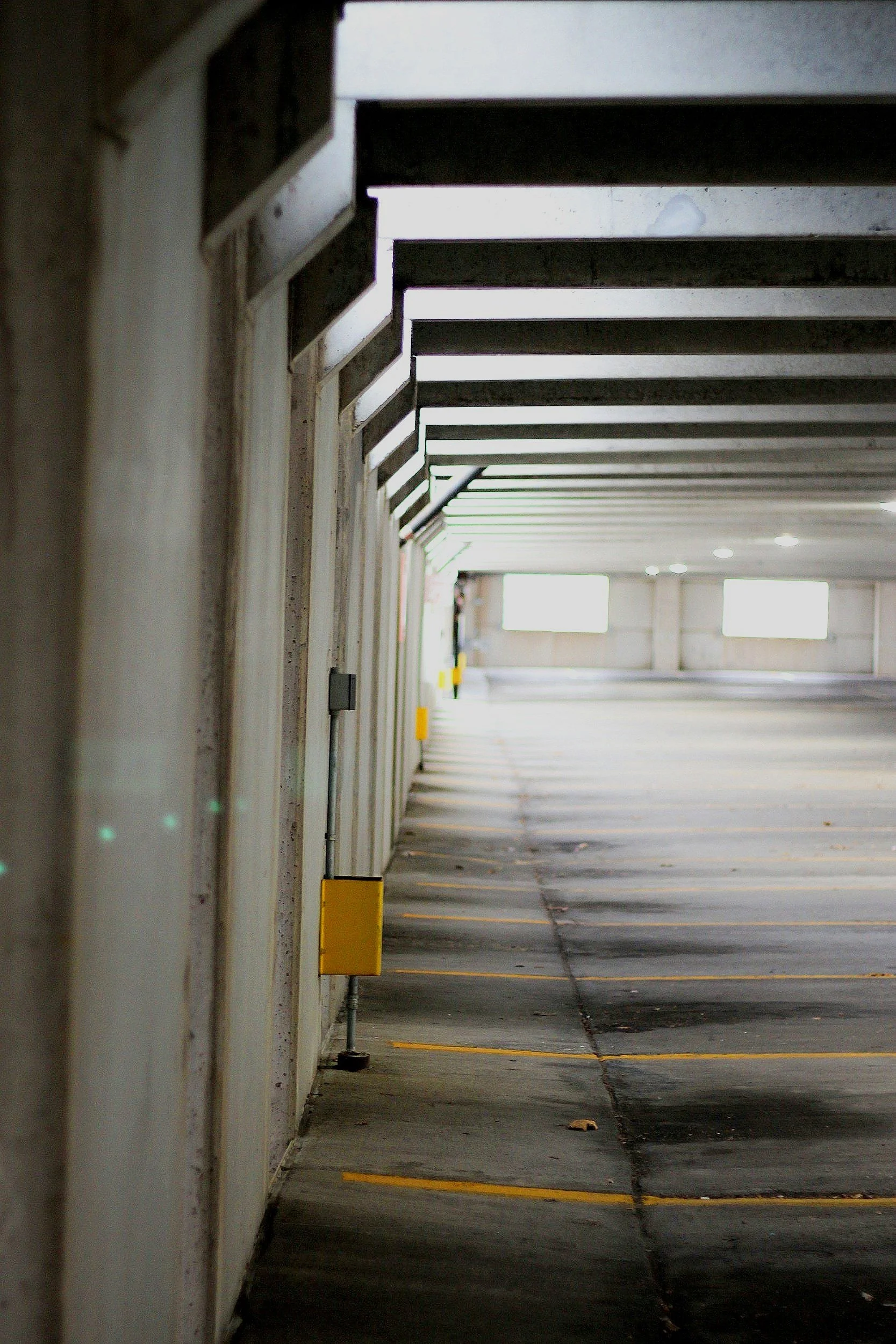
Parking Structure Inspections
Parking Structure Inspections
Periodic condition assessment and compliance coordination for New York City parking structures under Local Law 126 of 2021. Post & Lintel supports structure owners through QPSI engagement, condition assessment, DOB NOW filing, annual observations, and repair coordination across all five boroughs.
The 2021 partial collapse of a parking garage in lower Manhattan accelerated a city-wide mandate to assess every parking structure in New York — before failure, not after.
Local Law 126 of 2021, codified in Article 323 of Title 28 of the NYC Administrative Code and implemented through DOB Rule 1 RCNY §103-13, requires owners of parking structures throughout New York City to have their structures examined by a Qualified Parking Structure Inspector (QPSI) every six years and file a compliance report with the Department of Buildings. The program — known as the Periodic Inspection of Parking Structures (PIPS) — took effect January 1, 2022.
The law is structured similarly to FISP: inspections are staggered across sub-cycles by community district, condition ratings mirror the Safe / SREM / Unsafe framework, and filings are made through DOB NOW: Safety. The program addresses a structural environment that is particularly susceptible to accelerated deterioration — parking structures face heavy vehicle loading, chloride infiltration from deicing salts, freeze-thaw cycling, and often insufficient maintenance — compounding over time into conditions that can escalate rapidly.
What Qualifies as a Parking Structure
Under Local Law 126, a "parking structure" means any building or portion of a building used for parking or storing motor vehicles — including open parking garages, enclosed parking garages, and parking areas within mixed-use buildings. The law excludes unenclosed surface lots without a structural deck, one- or two-car garages serving exclusively one- and two-family dwellings, and auto service stations or showrooms. Owners uncertain about applicability may submit a Verification Request through DOB NOW: Safety to confirm whether their structure is subject to the program.
Filing Windows by Community District
Cycle 1 of the PIPS program runs from January 1, 2022 through December 31, 2027, divided into three sub-cycles by community district. A structure's sub-cycle is determined by the community district in which it is located. The QPSI must submit the condition assessment report within 60 days of completing the inspection, and no more than six years from the submission of the preceding report.
| Sub-Cycle | Geography | Filing Window | Status |
|---|---|---|---|
| 1A | Manhattan Community Districts 1–7 (lower Manhattan through Midtown) | Jan 1, 2022 – Dec 31, 2023 | Closed — late filings subject to penalties |
| 1B | Manhattan Community Districts 8–12 (upper Manhattan) + all Brooklyn Community Districts | Jan 1, 2024 – Dec 31, 2025 | Closed — late filings subject to penalties |
| 1C | All Bronx, Queens, and Staten Island Community Districts | Jan 1, 2026 – Dec 31, 2027 | Open — file before Dec 31, 2027 |
Cycle Frequency Change Starting 2028
Beginning January 1, 2028, the inspection cycle shortens from six years to four years. The DOB has not yet released the specific sub-cycle structure for cycles beginning in 2028. Structure owners should monitor DOB communications as 2028 approaches and engage QRWIs accordingly once the new cycle parameters are published.
New Construction — First Report Timing
For newly constructed parking structures, the initial compliance report must be filed six years from the date of the first Temporary Certificate of Occupancy (TCO), Interim Certificate of Occupancy (ICO), or Certificate of Occupancy (CO). If that date falls outside the structure's applicable sub-cycle window, the report must be filed within the next applicable sub-cycle.
The One-Time Initial Observation
In response to concerns that parking structures in Sub-cycles 1B and 1C could go uninspected for years while awaiting their sub-cycle windows, the DOB adopted 1 RCNY §103-16 in October 2023, effective November 2023. This rule required all Sub-cycle 1B and 1C parking structures to undergo a one-time initial observation — in addition to their standard six-year condition assessment — completed and filed by August 1, 2024.
The initial observation deadline of August 1, 2024 has now passed. Sub-cycle 1B structures that filed a complete, acceptable PIPS condition assessment report under 1 RCNY §103-13 before August 1, 2024 were exempt from the separate initial observation requirement. Sub-cycle 1C structures in the Bronx, Queens, and Staten Island were required to complete the initial observation regardless.
Initial Observation (1 RCNY §103-16)
A one-time early inspection for Sub-cycle 1B and 1C structures. Deadline: August 1, 2024 (passed). Performed by or under direct supervision of a DOB-designated QPSI. Filed through DOB NOW: Safety. Identifies Unsafe conditions before the main sub-cycle filing window opens.
Condition Assessment (1 RCNY §103-13)
The primary six-year periodic inspection. Full structural assessment with physical examination of minimum 10% of each element type. Annual observation checklist developed for use between cycles. Report filed through DOB NOW: Safety within 60 days of assessment completion.
Qualified Parking Structure Inspectors (QPSIs)
All parking structure condition assessments under Local Law 126 must be performed by or under the direct supervision of a Qualified Parking Structure Inspector. Only a QPSI can file compliance reports through DOB NOW: Safety. Structure owners cannot self-file, and general inspectors without QPSI designation are not authorized to conduct these assessments.
QPSI Qualification Requirements
A QPSI must be a New York State licensed Professional Engineer in good standing with the New York State Education Department and the NYC Department of Buildings. In addition to the PE license, the QPSI must have a minimum of three years of relevant experience working with parking structures and must complete a formal certification process administered by the NYC DOB. QRPSIs must maintain insurance coverage per 1 RCNY §101-07 and keep records of all inspections and tests for at least six years, available to the DOB upon request.
Scope of the Condition Assessment
The condition assessment must permit a complete physical examination of the parking structure and all its appurtenances. The QPSI must apply a professional standard of care to evaluate all building systems comprising the structure, including structural components, waterproofing systems, fireproofing and fire-stopping systems, and wearing surfaces. Before the inspection, the QPSI must review the most recent compliance report, all annual observation checklists from the prior cycle, available structural design or repair drawings, any open violations, and applicable FISP reports where the structure is part of a larger building.
Physical examinations must be performed on a minimum of 10% of each structural element type — beams, columns, and slabs — with focus on the most deteriorated locations identified by the QPSI's assessment program. The QPSI may employ load tests, optical surveys, non-invasive scanning, and cores as needed to support the condition assessment. When deficiencies are found, the QPSI must ascertain their cause and order any additional probes or tests required.
Annual Observation Checklist
During the first condition assessment, the QPSI develops a unique annual observation checklist containing baseline items to be inspected during annual observations conducted between the six-year condition assessments. These annual observations — required every year between filings — must also be performed or supervised by a QPSI. This ongoing requirement means that structure owners should maintain a relationship with a QPSI throughout the cycle, not only at the six-year assessment point.
What the Condition Assessment Covers
The PIPS condition assessment is a comprehensive structural and systems review of the entire parking facility. The following elements are evaluated as part of the inspection program developed by the QPSI for the specific structure.
- Structural concrete slabs and decks
- Beams, girders, and transfer structures
- Columns and bearing walls
- Foundation elements (where accessible)
- Ramps and level transitions
- Post-tensioning and prestress systems
- Waterproofing membranes and coatings
- Expansion joints and sealants
- Drainage systems and slope conditions
- Wearing surfaces and traffic coatings
- Spalling and delamination of concrete
- Rebar corrosion and section loss
- Chloride infiltration and salt damage
- Cracking — pattern, width, and depth
- Fireproofing and fire-stopping integrity
- Stair towers and elevator structures
- Façade and exterior envelope elements
- Guard rails and barrier systems
- Lighting and overhead clearance structures
- Mechanical, electrical, and life-safety systems
Safe, SREM, and Unsafe
Following the condition assessment, the QPSI assigns one of three ratings to the parking structure. Each classification carries specific compliance obligations and timelines under 1 RCNY §103-13.
Safe
The structure and all appurtenances are in sound condition with no defects or hazards requiring repair. The compliance report is filed and the structure remains in good standing until the next six-year assessment cycle. Annual observations continue between cycles per the QPSI's checklist.
SREM
Safe with Repairs and/or Engineering Monitoring. The structure is currently safe but has conditions requiring repair within a QPSI-specified timeframe of one to six years, along with ongoing engineering monitoring. SREM conditions that remain unaddressed at the next inspection are automatically reclassified as Unsafe. SREM reports cannot be filed for the same structure in two consecutive filing periods unless the QPSI attests that all prior-cycle defects have been corrected.
Unsafe
Conditions exist that are hazardous to persons or property. The QPSI must immediately notify the structure owner and the DOB. Public protection measures must be installed without delay, and all repairs must be completed within 90 days of filing. Owners who cannot complete repairs within 90 days may apply to the DOB for an extension of up to an additional 90 days. Upon completion, an amended compliance report must be filed within two weeks of completing repairs.
The SREM-to-Unsafe Escalation
A critical enforcement mechanism under 1 RCNY §103-13: any condition reported as SREM in a prior compliance report that remains uncorrected at the time of the current inspection must be reclassified as Unsafe — regardless of whether the physical condition has actually worsened. This automatic escalation is the same principle applied in FISP's SWARMP-to-Unsafe mechanism. Structure owners must treat SREM conditions as active compliance obligations with defined deadlines, not deferred items. A $2,000 one-time penalty applies for failure to correct an SREM condition within the QPSI-recommended timeframe.
Compliance Step by Step
The following outlines the standard sequence for meeting the PIPS condition assessment requirement within the applicable sub-cycle filing window.
Penalties for Non-Compliance
The DOB enforces the PIPS program through a structured civil penalty regime. Sub-cycle 1A and 1B filing windows have both closed — owners in those districts who have not filed are actively accruing penalties and should engage a QPSI immediately.
Late filing of an initial or compliance report carries a penalty of $1,000 per month from the missed deadline. Failure to file a report at all results in a $5,000 per year charge. An additional $2,000 one-time penalty applies for failure to correct an SREM condition within the QPSI-recommended timeframe. For Unsafe conditions, failure to install required public protection or complete repairs within the 90-day window exposes owners to further enforcement action, emergency repair orders issued by the city at the owner's expense, and civil liability exposure in the event of injury or property damage.
If Your Sub-Cycle Window Has Closed Without a Filing
Owners of structures in Sub-cycle 1A (Manhattan CDs 1–7) or Sub-cycle 1B (Manhattan CDs 8–12 and Brooklyn) whose filing windows have closed without an acceptable report on file should engage a QPSI and file as soon as possible to stop ongoing penalty accumulation. Filing late — while subject to accrued penalties — is significantly better than continued non-compliance. DOB contact for parking structure inquiries: DOB NOW: Safety or the Parking Structures program page at nyc.gov/buildings.
Common Conditions in NYC Parking Structures
Parking structures in New York City face a particularly aggressive set of environmental and operational stresses. The combination of heavy repetitive loading, chloride exposure from road salts tracked in by vehicles, moisture infiltration through deck surfaces and expansion joints, and the freeze-thaw cycling characteristic of the regional climate creates a deterioration pattern that can progress quickly — especially in structures that have not received regular maintenance.
Chloride-Induced Rebar Corrosion
The leading cause of structural deterioration in urban parking structures is corrosion of the embedded steel reinforcement triggered by chloride penetration — primarily from deicing salts. Once chlorides reach the rebar, corrosion begins, producing iron oxides that expand within the concrete section. This expansion generates internal tensile stress that cracks and eventually spalls the concrete cover, exposing the rebar further and accelerating the cycle. Spalling concrete directly above or adjacent to occupied areas is an immediate safety concern.
Waterproofing and Drainage Failure
Traffic-bearing decks rely on waterproofing membranes and protective coatings to prevent water and chloride infiltration into the structural slab. When membranes fail — at cracks, expansion joints, drains, or through wear — water penetrates the deck and begins the corrosion cycle. Clogged or damaged drains allow water to pond on deck surfaces, exacerbating infiltration and accelerating deterioration. Drainage maintenance and periodic recoating of deck surfaces are among the most cost-effective preventive measures for parking structures.
Post-Tensioning System Deterioration
Many post-tensioned concrete parking structures built from the 1960s through the 1990s are now experiencing deterioration of their prestressing systems. Corrosion of post-tensioning tendons — particularly in unbonded monostrand systems — can lead to sudden tendon failure, dramatically reducing the structural capacity of the affected span. Post-tensioning condition is a specific focus of PIPS assessments in structures of applicable construction type.
Expansion Joint Failure
Expansion joints accommodate thermal movement in the structure and are critical waterproofing transition points. Failed, compressed, or missing joint sealants are among the most common deficiencies found in parking structure assessments — and among the most important to address, as joint failures channel concentrated water flow directly into the structural system below.
Post & Lintel Parking Structure Services
Post & Lintel supports parking structure owners and managers across all phases of Local Law 126 PIPS compliance. Field observations and documentation may be performed by trained personnel; all regulated condition assessments, ratings, and DOB filings are handled by appropriately licensed professionals.
- Applicability and sub-cycle determination
- Verification Request coordination
- QPSI engagement and scheduling
- Prior report and violation record review
- Initial observation coordination
- Condition assessment program design
- Visual and physical inspection support
- Non-destructive testing coordination
- Concrete core and probe coordination
- Spalling and corrosion documentation
- Waterproofing condition assessment
- Annual observation checklist management
- Compliance report preparation and filing
- DOB NOW: Safety submission coordination
- SREM repair scope and scheduling
- Engineering monitoring coordination
- Unsafe condition response support
- Repair permit coordination
- Amended compliance report filing
- Multi-structure portfolio management
Who We Work With
Post & Lintel has supported parking structure inspection coordination across a range of ownership structures and facility types throughout New York City's five boroughs.
Frequently Asked Questions
Is my surface parking lot subject to Local Law 126?
No. Unenclosed surface lots without a structural deck are generally exempt from the PIPS inspection requirement. The law applies to parking structures — buildings or portions of buildings used for parking or storing motor vehicles, including open and enclosed garages. If your facility has any structural deck elements, confirm applicability with a QPSI or submit a Verification Request through DOB NOW: Safety.
How do I find my structure's sub-cycle?
The sub-cycle is determined by the community district in which the parking structure is located. Manhattan Community Districts 1–7 are Sub-cycle 1A; Districts 8–12 and all Brooklyn districts are Sub-cycle 1B; all Bronx, Queens, and Staten Island districts are Sub-cycle 1C. The DOB's Cycle 1 Sub-Cycle Diagram is available on the NYC DOB parking structures page.
What is an annual observation and is it required?
Annual observations are yearly interim inspections conducted between six-year condition assessments, using the checklist developed by the QPSI during the most recent full assessment. They are a separate ongoing requirement — not a substitute for the six-year assessment. Annual observations must be performed by or under QPSI supervision and documented, but reports are not filed with the DOB unless an Unsafe condition is identified.
Can an SREM report be filed two cycles in a row?
No, with a narrow exception. SREM reports cannot be filed for the same structure in two consecutive filing periods unless the QPSI attests in the second report that all defects identified in the prior SREM report have been fully corrected. If prior-cycle SREM conditions remain unaddressed at the current inspection, they must be reclassified as Unsafe.
How long does an owner have to repair Unsafe conditions?
All repairs to correct Unsafe conditions must be completed within 90 days of filing the Unsafe compliance report. If repairs cannot be completed within 90 days, the owner may apply to the DOB for an extension of up to an additional 90 days. Upon completion, the QPSI must re-inspect and file an amended compliance report within two weeks.
What if my sub-cycle window has closed without a filing?
Penalties are accruing at $1,000 per month from the missed deadline, with a $5,000 per year charge for failure to file. Engaging a QPSI and filing as soon as possible stops ongoing penalty accumulation. Sub-cycle 1A (closed 2023) and 1B (closed 2025) owners who have not filed should act immediately. Sub-cycle 1C owners have until December 31, 2027.
How does PIPS relate to FISP for a mixed-use building?
If a building has both a façade subject to FISP (over six stories) and a parking structure subject to PIPS, both programs must be satisfied independently. The QPSI reviewing the parking structure should coordinate with FISP reports where applicable — the parking structure rule requires review of FISP reports as part of pre-inspection due diligence — but each program has its own inspector, filing cycle, and DOB NOW submission track.
What does a parking structure assessment cost?
Costs vary based on the structure's size, number of levels, construction type, age, condition, and the extent of testing required. For straightforward smaller structures, fees may be in the range of several thousand dollars; for larger, more complex facilities or those with significant deterioration, assessment and testing costs will be substantially higher. Post & Lintel scopes each engagement individually based on the specific structure.
Questions about your parking structure's compliance status? Reach out to discuss your sub-cycle, inspection timeline, or prior filing history.
Contact Us